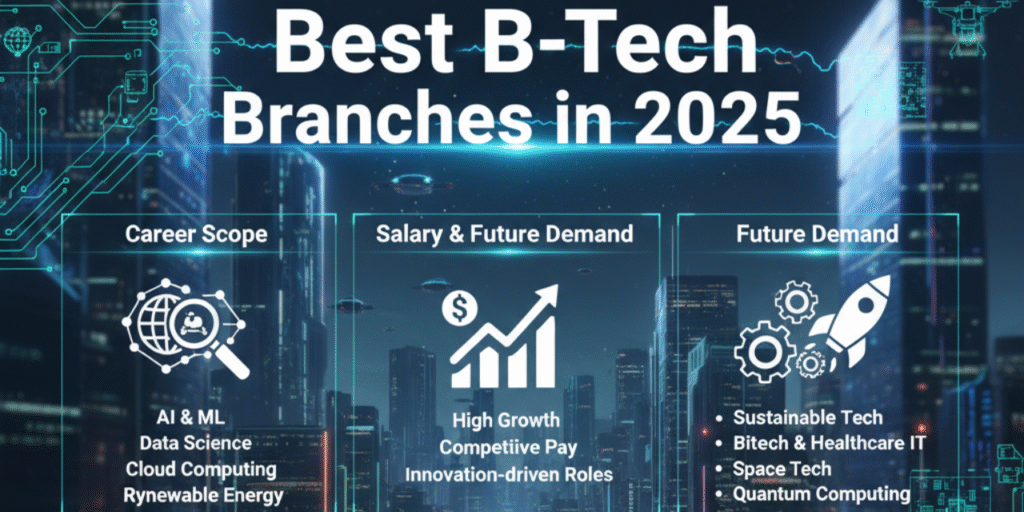
Choosing the right B.Tech branch is one of the most important decisions for any engineering aspirant. With rapid technological advancements, shifting job markets, and evolving industry needs, students must pick a branch that not only aligns with their interests but also offers strong career growth, salary potential, and long-term stability.
In this detailed blog, we break down the Best B.Tech Branches in 2025, highlighting their future demand, scope, salary trends, job opportunities, and industry relevance to help you make a smart, future-ready decision.
Why Choosing the Right B.Tech Branch Matters in 2025
Engineering fields are changing faster than ever due to advancements in AI, automation, renewable energy, and semiconductor technologies. A branch that was popular five years ago may not be the hottest pick today. The right branch can:
- Increase your chances of high-paying jobs
- Open opportunities in fast-growing industries
- Provide global career prospects
- Ensure long-term stability
- Allow specialization in cutting-edge technologies
With new sectors emerging and old ones transforming, a strategic choice matters more than ever.
Top 10 Best B.Tech Branches in 2025 (With Career Scope, Salary & Demand)
Below are the most promising engineering branches for 2025 based on industry growth, employment trends, innovation pace, and future technologies.
1. Computer Science Engineering (CSE)
Overview
CSE remains the most in-demand engineering branch due to its wide applicability across all industries. With digital transformation accelerating, companies need skilled software engineers, developers, and tech innovators.
Career Scope
- Software Development
- Cloud Computing
- Web/App Development
- DevOps Engineering
- Product Engineering
- System Architecture
- Research & Algorithms
Average Salary
- Freshers: ₹5–12 LPA
- Experienced: ₹20–60 LPA (varies by skill and company)
Future Demand
CSE will remain the hottest engineering branch due to AI integration, automation, cloud expansion, and the rise of tech-driven industries.
2. Artificial Intelligence & Machine Learning (AI & ML)
Overview
AI & ML is one of the fastest-growing engineering specializations worldwide. Companies across sectors like healthcare, finance, robotics, and automation rely heavily on AI technologies.
Career Scope
- Machine Learning Engineer
- AI Research Scientist
- Data Scientist
- NLP Engineer
- Computer Vision Engineer
- Automation Specialist
Average Salary
- Freshers: ₹7–15 LPA
- Mid-level: ₹15–30 LPA
- Senior/Expert: ₹40 LPA and above
Future Demand
AI will continue to dominate the job market as industries adopt automation and predictive technologies. The scope will be massive for years to come.
3. Data Science & Big Data Engineering
Overview
Every company today depends on data-driven decisions. Data Science has emerged as a powerful branch that blends mathematics, algorithms, programming, and business insights.
Career Scope
- Data Scientist
- Business Analyst
- Data Engineer
- BI Analyst
- Data Architect
Average Salary
- Freshers: ₹6–12 LPA
- Experienced: ₹15–35 LPA
Future Demand
Data Science is expected to grow exponentially due to increasing digital footprints and data-led business environments.
4. Electronics & Communication Engineering (ECE)
Overview
ECE is a versatile branch bridging hardware and software. Its relevance has grown due to IoT, 5G, semiconductor development, and embedded technologies.
Career Scope
- Embedded Systems Engineer
- VLSI Engineer
- Telecommunication Engineer
- IoT Developer
- Robotics Engineer
- Chip Design Engineer
Average Salary
- Freshers: ₹4–10 LPA
- Experienced: ₹12–30 LPA
Future Demand
With India focusing on semiconductor manufacturing and 5G expansion, ECE careers will see a major boom.
5. Electrical & Electronics Engineering (EEE)
Overview
EEE plays a crucial role in power systems, renewable energy, smart grids, EV infrastructure, and automation.
Career Scope
- Electrical Engineer
- Control Systems Engineer
- Renewable Energy Specialist
- Power Plant Engineer
- Smart Grid Engineer
Average Salary
- Freshers: ₹3–8 LPA
- Experienced: ₹10–25 LPA
Future Demand
With clean energy and EV adoption rising, EEE will see strong and sustained growth.
6. Robotics & Automation Engineering
Overview
Automation is the backbone of Industry 4.0. Robotics engineering combines mechanical, electronics, AI, and programming to create intelligent automated systems.
Career Scope
- Robotics Engineer
- Automation Engineer
- Mechatronics Specialist
- Industrial Automation Consultant
- Drone/Autonomous Systems Engineer
Average Salary
- Freshers: ₹6–12 LPA
- Experienced: ₹15–30 LPA
Future Demand
The shift toward smart factories and automated environments ensures continued demand for robotics professionals.
7. Mechanical Engineering (with Industry 4.0 Focus)
Overview
Mechanical Engineering remains relevant when paired with modern technologies like AI, robotics, automotive engineering, and EV development.
Career Scope
- Design Engineer
- Automotive Engineer
- Manufacturing Engineer
- Robotics Integration Engineer
- HVAC Engineer
Average Salary
- Freshers: ₹3–7 LPA
- Experienced: ₹10–20 LPA
Future Demand
Mechanical engineers with knowledge of automation, CAD tools, and robotics are highly valued.
8. Civil Engineering (With Smart Infrastructure Focus)
Overview
Civil Engineering is evolving with smart cities, sustainable construction, disaster management, and infrastructure growth in developing economies.
Career Scope
- Structural Engineer
- Construction Manager
- Geotechnical Engineer
- Surveying Engineer
- Smart Infrastructure Planner
Average Salary
- Freshers: ₹3–6 LPA
- Experienced: ₹10–25 LPA
Future Demand
With rapid urbanization, demand for qualified civil engineers will remain strong.
9. Biomedical Engineering / Biotechnology
Overview
The healthcare industry is booming with medical innovations, biotech research, and medical device development.
Career Scope
- Biomedical Engineer
- Medical Equipment Designer
- Biotech Research Scientist
- Clinical Engineer
- Biomaterials Engineer
Average Salary
- Freshers: ₹4–8 LPA
- Experienced: ₹12–30 LPA
Future Demand
A strong and rapidly growing demand due to advancements in healthcare technology.
10. Aerospace Engineering
Overview
Aerospace engineering is an elite branch focusing on aviation, space technology, drones, and satellite research.
Career Scope
- Aerospace Engineer
- Propulsion Engineer
- Aircraft Design Engineer
- Satellite & Space Research Engineer
- Drone Technology Specialist
Average Salary
- Freshers: ₹6–10 LPA
- Experienced: ₹15–40 LPA
Future Demand
With increasing investments in space agencies and defense technology, demand is rising steadily.
Which B.Tech Branch Is Best for You in 2025?
Here is a quick guide based on your strengths and interests:
- Choose CSE / AI / Data Science if you love coding, analytics, and software development.
- Choose ECE / EEE if you’re interested in hardware, chips, IoT, and electronics.
- Choose Robotics / Mechanical if you love machines, design, and automation.
- Choose Biomedical / Biotechnology if you’re passionate about healthcare tech.
- Choose Aerospace if you’re fascinated by aircraft, space, and drones.
- Choose Civil if you see yourself building smart cities and infrastructure.
Final Thoughts
The “Best B.Tech Branch in 2025” depends on your interests, skills, and career goals — but branches like CSE, AI, Data Science, ECE, Robotics, and EEE lead the market in terms of salary, scope, and future demand.
Before choosing a branch, consider:
- Your long-term interest
- Market trends
- Future-proof skills
- College reputation
- Availability of internships and industry exposure
A smart decision today will shape a successful engineering career tomorrow.